POCO X7 Pro vs Redmi Note 14 Pro Plus: The Ultimate 2026 Mid-Range Battle
Detailed POCO X7 Pro vs Redmi Note 14 Pro Plus comparison. Check gaming benchmarks, 200MP camera tests, battery endurance, and regional prices.
In this complete POCO X7 Pro vs Redmi Note 14 Pro Plus comparison, we are breaking down two absolute heavyweights in the highly competitive sub-₹30,000 (roughly $350) price bracket. If you are shopping for a new smartphone in 2026, you have likely realized that the mid-range market is where the real innovation is happening.
While both of these devices are manufactured under the Xiaomi corporate umbrella, they are engineered for completely different types of users. This isn't just a simple rundown of the spec sheets; this is a comprehensive, deep-dive comparison from the Gadget96 review team. Be sure to check out our other in-depth smartphone reviews to help you spend your money wisely.
The TL;DR Verdict: Which should you buy?
In a rush? Here is the distilled essence of our comparison:
- Choose the POCO X7 Pro if: You are a hardcore mobile gamer, a power user who constantly multitasks, or someone who despises charging their phone. Its raw CPU/GPU performance is unmatched at this price, and its colossal battery is a genuine multi-day performer.
- Choose the Redmi Note 14 Pro+ if: You care deeply about photography, want a phone that feels like a $1,000 flagship in your hand, and prefer a hyper-immersive curved display for watching media. Check out our phone buying guides if camera quality is your primary focus.
1. Design & Build Quality: Rugged Utility vs. Premium Elegance
When you hold both phones side by side, their differing philosophies are immediately apparent.
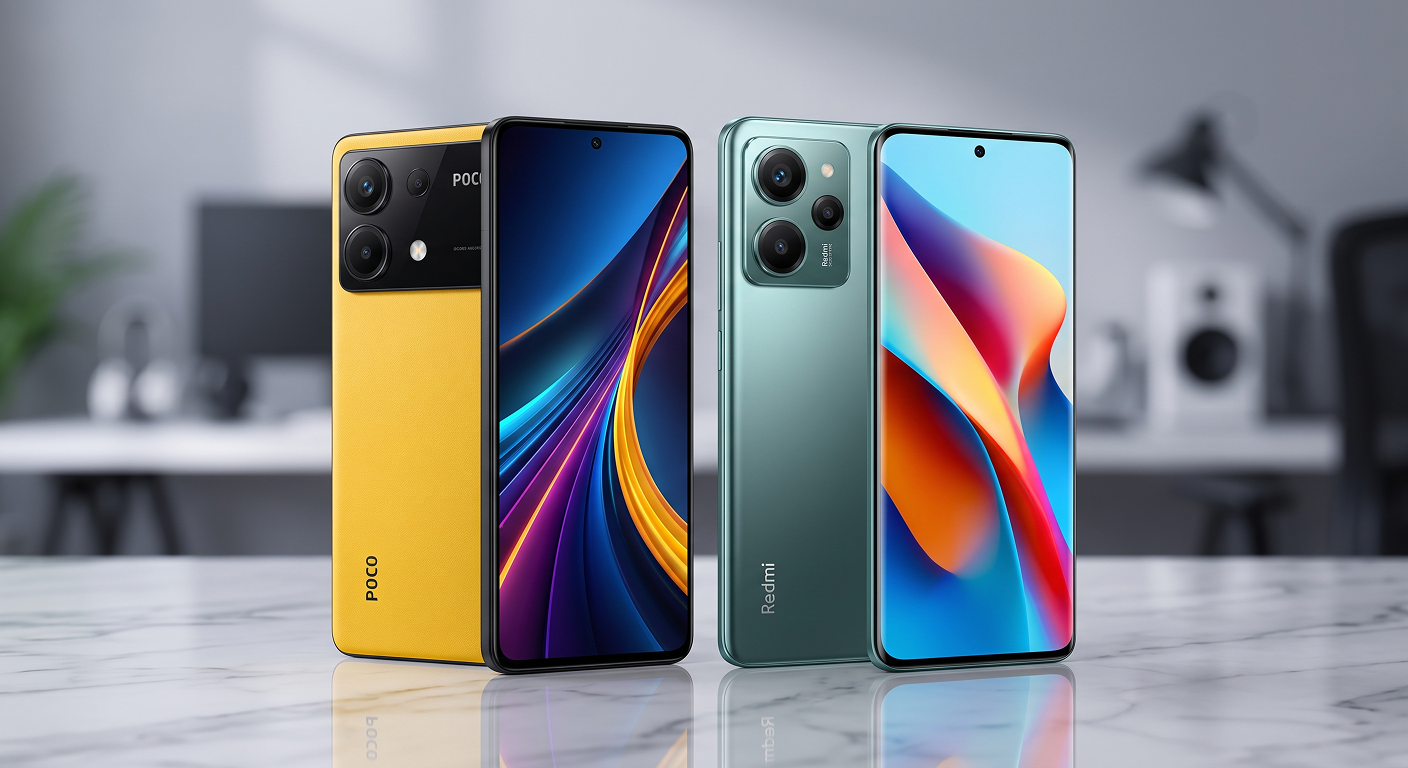
The POCO X7 Pro unapologetically embraces its "gamer-centric" roots. Depending on the colorway, you get a textured vegan leather back (the iconic POCO Yellow is a standout) or a matte polycarbonate finish. It’s slightly thicker, but that thickness houses a massive battery. The flat edges provide an excellent grip, and it boasts an impressive IP69 rating, meaning it can survive high-temperature, high-pressure water jets.
Conversely, the Redmi Note 14 Pro+ is a masterclass in mid-range elegance. Xiaomi has refined its glass-sandwich design, utilizing a reinforced metal composite frame sandwiched between Gorilla Glass Victus 2 on the front and polished glass on the back. The seamless curves make it feel incredibly slim for one-handed use, and it holds a standard IP68 submersion rating.
2. POCO X7 Pro vs Redmi Note 14 Pro Plus: The Display Battle
Both smartphones feature stunning 6.67-inch AMOLED panels with a 120Hz refresh rate and a sharp 1.5K resolution. However, the form factor dictates the experience.
- The POCO Experience (Flat): POCO opted for a completely flat display protected by Gorilla Glass 7i. For mobile esports players, this is non-negotiable because it prevents light distortion at the edges. We measured an intense peak brightness of 3,200 nits, making it perfectly legible even under harsh midday sunlight.
- The Redmi Experience (Curved): The Note 14 Pro+ utilizes a 3D curved display. While it peaks slightly lower at around 3,000 nits, its visual appeal is undeniable. The curves make the side bezels virtually disappear, creating a cinematic, edge-to-edge canvas.
3. Performance & Gaming: Dimensity 8400 Ultra vs Snapdragon 7s Gen 3
If you are looking for the absolute best performance-per-dollar ratio, this is where the comparison becomes one-sided.

The POCO X7 Pro is armed with the heavily optimized MediaTek Dimensity 8400 Ultra processor. This chipset is a benchmark destroyer in the mid-range segment, pushing excellent frame rates. In real-world tests, running Genshin Impact at maximum settings yielded a remarkably stable experience without uncomfortable heat buildup.
The Redmi Note 14 Pro+ opts for Qualcomm's Snapdragon 7s Gen 3. Let’s be clear: this is an incredibly power-efficient chip that handles daily multitasking with zero lag. However, its GPU architecture is tailored for efficiency and Image Signal Processing (ISP) rather than raw frame-pushing. In heavy gaming scenarios, it throttles sooner than the POCO.
4. Camera Capabilities: Megapixels and Optics
If the POCO wins on raw power, the Redmi Note 14 Pro+ takes the crown in the photography department—and it's not even a close fight.

Redmi continues its tradition of bringing flagship optics to the masses. The Note 14 Pro+ boasts an ultra-large 200MP primary sensor with Optical Image Stabilization (OIS). The dynamic range is excellent, and the sensor is so large that the digital zoom practically looks optical.
The POCO X7 Pro uses a reliable but standard 50MP Sony LYT-600 main sensor. It benefits from zero shutter lag, making it great for capturing fast-moving subjects. However, when examining photos on a larger monitor, the POCO's images show softer details and slightly artificial sharpening compared to the Redmi.
5. Battery Life & Charging Speeds
Battery anxiety is a thing of the past with both of these devices, but they solve the problem using different methods.
The POCO X7 Pro features a revolutionary 6,000mAh (up to 6,550mAh in some regions) silicon-carbon battery. This high-density tech allows POCO to fit a massive capacity into a normal form factor. For the average user, this translates to nearly two full days of battery life. It charges at a brisk 90W.
The Redmi Note 14 Pro+ uses a more traditional 5,110mAh battery, but it focuses heavily on top-up speed. Equipped with Xiaomi's 120W HyperCharge technology, you can plug this phone in and have a 100% full battery in under 30 minutes.
6. Comprehensive Specs Comparison Table
Here is the side-by-side hardware breakdown of exactly what you get inside the box.
| Feature / Spec | POCO X7 Pro 5G | Redmi Note 14 Pro+ 5G |
|---|---|---|
| Display Tech | 6.67" Flat AMOLED, 120Hz | 6.67" Curved AMOLED, 120Hz |
| Processor (SoC) | MediaTek Dimensity 8400 Ultra | Qualcomm Snapdragon 7s Gen 3 |
| Rear Camera Setup | 50MP (Main OIS) + 8MP (Ultrawide) | 200MP (Main OIS) + 8MP (UW) + 2MP (Macro) |
| Selfie Camera | 20MP | 20MP |
| Battery Capacity | 6,000 mAh - 6,550 mAh | 5,110 mAh |
| Charging Speed | 90W Wired HyperCharge | 120W Wired HyperCharge |
| Ingress Protection | IP69 (Dust & High-Temp Water) | IP68 (Dust & Water Immersion) |
| Operating System | Android 15 (HyperOS 2.0) | Android 14 (HyperOS) |
7. Current Regional Pricing & Availability
To help our readers across different regions make an informed decision, we’ve compiled the expected base model pricing based on current launch data and tax structures for 2026.
| Region (Currency) | POCO X7 Pro (Base) | Redmi Note 14 Pro+ (Base) |
|---|---|---|
| Global (USD) | ~$374 | ~$373 |
| India (INR) | ₹23,999 – ₹25,999 | ₹27,280 – ₹31,999 |
| Nepal (NPR) | रू 41,999 – रू 43,999 | रू 50,999 – रू 53,999 |
8. Final Thoughts: Making the Right Choice
Ultimately, choosing between these two comes down to identifying what kind of smartphone user you actually are.
If you treat your phone like a portable gaming console, the POCO X7 Pro is an absolute no-brainer. You are getting flagship-tier processing power and a battery that refuses to die, all for a remarkably low price.
However, if you want a device that feels luxurious, takes breathtaking photos for your social feeds, and features a gorgeous curved display, the Redmi Note 14 Pro+ easily justifies its price tag.
Frequently Asked Questions
Which phone is better for BGMI and Genshin Impact?
The POCO X7 Pro is significantly better for heavy gaming. Its MediaTek Dimensity 8400 Ultra processor outperforms the Snapdragon 7s Gen 3 in sustained graphical rendering, and its flat display is much better for touch accuracy.
Does the POCO X7 Pro have a headphone jack?
No, like most modern mid-range and flagship devices in 2026, both the POCO X7 Pro and the Redmi Note 14 Pro+ have removed the 3.5mm headphone jack. You will need to use Bluetooth earbuds or a Type-C dongle.
Is the Redmi Note 14 Pro+ camera actually good?
Yes, it is exceptional for its price. The 200MP primary sensor with OIS captures highly detailed, color-accurate photos in daylight and performs very well in low-light conditions, easily beating other phones in the sub-₹30,000 category.